release edition [084] read time [7 minutes] Welcome to The Multifamily Download, a weekly newsletter where I provide institutional insights to help you build an exceptional Multifamily career. Forwarded this email? Subscribe here. My Multifamily acquisitions software is launching soon! Click here to join the waitlist. Today at a Glance:
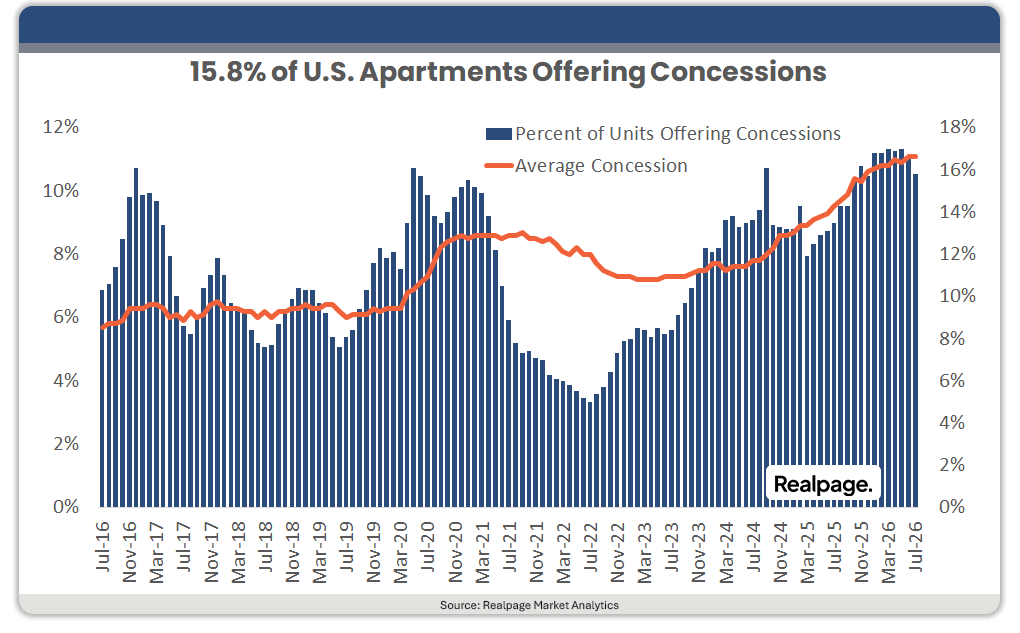
The 2H26 RecoveryOne of the themes I've been writing about in 2026 is this: I expected rent growth to be relatively weak in the first half of the year (mirroring the second half of 2025) and a recovery to begin in the second. I even went "on the record" as this was prediction #1 in TMD 052. More recently in TMD 076, I graded this prediction as "tracking" at the mid-year mark, and in TMD 079 I called the Q2 numbers the strongest evidence yet that a 2H 2026 recovery may still be on schedule. The data is starting to agree. Earlier this month, CoStar / Apartments.com raised their near-term rent growth outlook. They now have national rent growth at 1.4% in Q3 and 1.9% in Q4, up from a prior Q4 outlook of just 0.5%. Their revision is due to second-quarter rents coming in slightly ahead of expectations, stronger employment assumptions, and real progress absorbing the 2024 to 2025 supply glut. Vacancy is expected to hold near 8.2% through year end. Supply continues to fall, and I doubt that picture will reverse anytime soon due to the elevated yield curve. Yardi Matrix now projects completions falling from roughly 490,000 units this year to about 444,000 in 2027, and units under construction or in pre-lease dropped 21.1% year over year to about 445,000 at the end of Q2. Market-rate completions in 2027 are penciled at around 250,000 units, roughly 11% below 2020 levels. Here's my one caveat, and it's the same one CoStar mentioned: downside risks still exist. Energy prices are sticky, the labor force is growing slowly and unevenly, and July's initial jobs print showed a net loss of 23K jobs. A national forecast is an average, and averages are good for gaining relative knowledge and directional trends, but must not be extrapolated into asset-level perspectives. As I've written about previously, Multifamily real estate is both local and hyper-local, so knowing the market, the submarket, and the street corners are what matter the most. Summary Rent forecasts are improving. Supply is finally dwindling and demand has been solid, but there are downside risks, so I don't think the inevitability of future rent growth has been achieved yet even as new supply recedes. Actionable Takeaway Focus on a submarket's remaining deliveries and pre-lease pipeline, and then model when the submarket's supply pressure actually burns off. In a market still delivering more than 3% of stock, it's likely prudent to underwrite flat rents for the remainder of 2026, and even into 1H 2027 in some cases. Concessions ContinueIf the positive forecast above is the good news, then the concession data is the fine print. In July, 15.8% of stabilized units nationally were offering a concession, down 0.7 points from June but still up 2.3 points from a year ago, and the highest July reading since 2011, per this recent RealPage blog. The average discount was 11.1%, which is close to six weeks of free rent on a twelve-month lease. On the surface, that looks like slow, steady improvement, but looking one layer deeper is where the data gets interesting. Class A concessions fell to 12.5% in July, down more than a point and now below where it sat a year ago. However, Class C went the other way, up to 21.5%, up more than five points year over year. Surprisingly to many market participants, the oldest, most affordable product is the segment now giving away the highest concession percentage. This is backwards from the usual supply story since new supply hits Class A, so it would logically follow that Class A should hurt the most. Instead, the pain is migrating down the quality stack, and I would argue that this phenomenon has less to do with supply and more to do with the renter. This is the K-Economy that I've written about since TMD 004 showing up inside the rent roll. The Class C tenant is the one feeling inflation pressures, lower savings, and that's translating to softness at the bottom of the sector. it also collides with the renewal cliff I laid out in TMD 063. Leases signed with heavy concessions last year are expiring now, and if you're a Class B or C operator, keeping the resident usually beats winning the rate fight because a vacancy backfills at an even lower effective rent once factoring in turn costs and vacancy costs.
Summary The national concession number is drifting down, but the national average is hiding a divergence happening beneath the surface. Class A, thanks to healthy rent-to-income ratios, is healing as supply is dwindling, but Class C is struggling because, generally speaking, the renter continues to be financially stretched. Actionable Takeaway Know which class you're actually competing in before you set your leasing strategy. Class A in a supply-heavy submarket should focus on leasing velocity for physical occupancy now while concessions burn off. Class B or C operators should protect the back door, price lease renewals to retain residents, and fight hard to maintain economic occupancy. Career GrowthLastly, I want to speak to those of you that are earlier in your careers, because ironically, a slow transaction market can be one of the best times to grow in your career. When deals are happening, everyone is busy and it's difficult to slow down to think strategically about developing specific skills to build out a well-rounded skillset. If I were in the first few years of my career, here are three things I'd be focusing on while the market is still relatively slow. First, learn and become proficient in the parts of the business that don't stop in a downturn. Acquisitions slows down, but asset management, construction management, and even financing (refinances, modifications, etc.) do not. The person on the team who understands a loan modification, an insurance RFP, or how to build a proforma reforecast possesses valuable skills across cycles. Second, become the person with a differentiated and defensible point of view. Anyone can pull a comp set, but the analyst who can tell their boss what the comps mean, or where they'd push back on the broker's narrative, is the one who gets pulled into the room where decisions happen. And on this point: Don't strive to become or avoid being a contrarian just for contrarian's sake. Develop your perspective independently based on the data and facts, and let your perspective fall where it may. For more on thinking critically, read TMD 009. Third, remain visible and become useful while it's quiet. Slow markets are when relationships get built, because everyone has a little more time and a lot less deal noise. The coffees, the follow-ups, and the thoughtful questions to someone a few years ahead of you become mechanisms for broadening your network and deepening your relationships. Summary Down markets have a way of reshuffling the labor deck. When cycles turn, the premium for human capital can quickly shift from speed of output to the depth of judgment and the durability of relationships. And coincidentally, focusing on the two latter (judgement and relationships) often leads to improving the former (speed of output). Actionable Takeaway Pick a skill this quarter to develop on your own time. It could be by self-educating, or asking to join a meeting you don't typically attend. Regardless, make the effort to build a new skillset to add to your repertoire. Skills always compound. Weekly ListenThis week's listen is The Rent Roll Episode 98, hosted by Jay Parsons, with guests John Hofmann and Karen Purcell of JPMorgan's commercial banking group. It's a fitting follow-on to the forecast section above, because it's another data point of institutional capital leaning into rental housing. Hofmann and Purcell walk through JPMorgan's roughly $750 billion housing commitment over the next decade and what they're actually seeing in the multifamily debt market right now, from where liquidity is showing up to how they're thinking about credit as fundamentals start to broaden. You can listen to the full episode here. Wrap UpThat's it for today. I hope you found this edition of The Multifamily Download insightful. Consider sharing this link to The Multifamily Download with a friend or colleague. Your feedback is appreciated, so feel free to reply anytime. Thanks for reading. See you next week! Forwarded this email? Sign up here. Join me on LinkedIn | Twitter | Website |
The Multifamily Download · August 23, 2026
Rent Forecasts Turn & 3 Career Moves
Get the next issue
Free every Saturday, read by thousands of multifamily professionals.
Subscribe Free →